
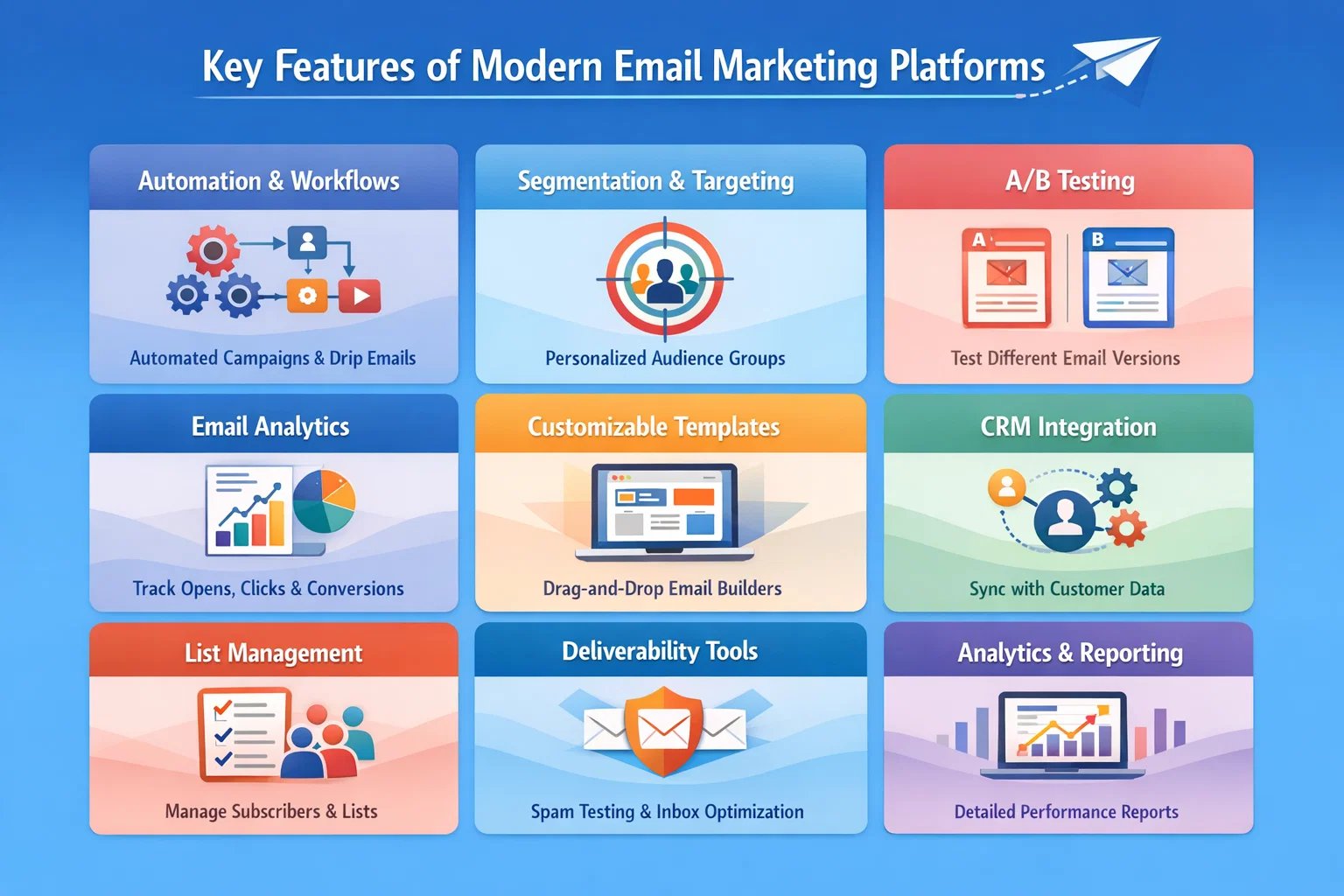
Email marketing platforms have evolved dramatically over the last decade. What began as simple bulk email tools has transformed into a sophisticated ecosystem of automation, analytics, artificial intelligence, and customer data platforms designed to drive measurable business growth.
For businesses targeting Tier-1 markets such as the United States, United Kingdom, Canada, Australia, and Europe, modern email marketing platforms are now a core revenue channel. They are built to support scalability, compliance, personalization, and deep integration with SaaS, CRM, and e-commerce systems.
What Is an Email Marketing Platform?
An email marketing platform is a cloud-based software solution that allows businesses to create, manage, automate, deliver, and analyze email communications with prospects and customers. Modern platforms extend far beyond email sending by incorporating automation workflows, AI-driven insights, and multi-channel engagement capabilities.
These platforms are widely used across industries such as SaaS, finance, insurance, e-commerce, healthcare, and enterprise B2B marketing.
Why Modern Email Marketing Platforms Matter
- Reduced dependency on paid advertising platforms
- Higher customer lifetime value
- Predictable and scalable revenue
- Accurate performance tracking
Core Features of Modern Email Marketing Platforms
1. Advanced Email Automation
Automation forms the backbone of modern email marketing. Businesses can design complex workflows triggered by user behavior, lifecycle stages, or timing rules. Common use cases include onboarding sequences, lead nurturing, abandoned cart recovery, renewal reminders, and upsell campaigns.
2. AI-Driven Personalization
Artificial intelligence enables personalization at scale by analyzing customer behavior and predicting preferences. AI dynamically adjusts content, subject lines, and timing to improve engagement, conversions, and deliverability.
3. Audience Segmentation and Targeting
Modern segmentation tools allow targeting based on demographics, purchase history, engagement level, behavioral signals, and lifecycle stage—ensuring the right message reaches the right audience at the optimal time.
4. CRM and SaaS Integrations
Seamless integration with CRM systems, payment platforms, analytics tools, and customer support software provides a unified customer view and enables precise revenue attribution across marketing channels.
5. High-Performance Email Deliverability
Deliverability features such as domain authentication, sender reputation monitoring, spam testing, and inbox placement optimization ensure emails consistently reach recipients’ primary inboxes.
6. Detailed Analytics and Reporting
Modern platforms provide real-time insights into open rates, click-through rates, conversions, engagement trends, and revenue attribution—enabling continuous optimization and smarter marketing decisions.
Feature Comparison: Traditional vs Modern Email Platforms
| Feature | Traditional Platforms | Modern Platforms |
|---|---|---|
| Email Automation | Basic | Advanced Workflows |
| Personalization | Limited | AI-Driven |
| Analytics | Open & Click Rates | Revenue & Attribution |
| Integrations | Few | CRM, SaaS, API-First |
| Compliance | Manual | Built-In GDPR & CAN-SPAM |
Enterprise-Grade Security and Compliance
Modern email marketing platforms are designed with enterprise-level security standards and global regulatory compliance. They support GDPR, CAN-SPAM, CASL, and other frameworks through encryption, consent tracking, audit logs, and role-based access control.
Scalability for High-Growth Businesses
Scalable infrastructure allows businesses to manage millions of contacts, send high-volume campaigns, and operate globally without compromising speed or reliability—making modern platforms ideal for rapidly growing organizations.
Multi-Channel Marketing Capabilities
Leading platforms now extend beyond email to include SMS marketing, push notifications, and in-app messaging. This enables consistent omnichannel customer experiences and stronger engagement across touchpoints.
AI and Predictive Analytics
AI-powered capabilities such as send-time optimization, predictive churn detection, automated subject line testing, and intelligent segmentation help businesses maximize performance while reducing manual effort.
How These Features Drive High ROI
- Reduced customer acquisition costs
- Improved engagement and retention
- Higher customer lifetime value
- Better monetization of existing audiences
Choosing the Right Email Marketing Platform
- Depth of automation capabilities
- Integration with CRM and SaaS tools
- Analytics and reporting strength
- Deliverability reputation
- Scalability and pricing structure
Conclusion
Modern email marketing platforms are essential for businesses aiming to grow in competitive, high-value markets. With advanced automation, AI-driven personalization, enterprise security, and deep analytics, these platforms empower organizations to build stronger customer relationships and achieve predictable revenue growth.
For companies focused on scalability and long-term ROI, investing in a modern email marketing platform is a strategic decision that delivers measurable and sustainable results.